ABOUT US
HOME > ABOUT US

PROFILE

Company Name Toshimaya Corporation
Address 1-5-1 Sarugaku-cho Chiyoda-ku, Tokyo 101-0064 JAPAN
Telephone +81-3-3293-9111
FAX +81-3-3293-9117
Foundation 1596 (Keicho 1)
Incorporation Feb. 1, 1936 (Showa 11)
Capital 25 million yen
Board members Chairman : Takayuki Yoshimura, Ph.D
President : Toshiyuki Yoshimura, Ph.D
Director : Tadayuki Tanaka
Director : Youko Kimura
Auditor : Taketoshi Suzuki
Business domains 1) Sake brewery, wholesale and internet-sale of sake, shirozake (white sake), mirin (sweet cooking sake), alcoholic beverage, shoyu (soy sauce), and other food for business use.
2) Real estate.
Major Suppliers Toshimaya Shuzo Sake Brewery Co. Ltd., Chiba Shoyu Co. Ltd., Hiroya-Kokubu Co. Ltd., Nihon Shurui-hanbai Co. Ltd., Mitsui Foods Co. Ltd., JFLA Inc. (Marukin-Chuyu), and others.
Major Customers 1)Soba /Udon restaurants in Tokyo, Saitama, Chiba, and Kanagawa area.
2)Metropolitan hospitals, rice snack manufacturers, sushi restaurants, unagi(eel) restaurants, pubs etc.
3)Mitsukoshi, Tokyu, Hankyu-Hanshin and other department stores.
4)Kinokuniya, Seijo-Ishii, and other high-graded supermarkets.
5)Personal customers through internet.
Major Banking Partner Sumitomo Mitsui Bank (Kanda branch)
Bank of Tokyo-Mitsubishi UFJ (Jinbo-cho branch)
Japan Finance Corporation (Tokyo branch)
Related companies Toshimaya Shuzo Sake Brewery Co. Ltd.
Toshimaya Building Ltd.
Affiliated unions Toto Norenkai (association of 52 longstanding stores for over three generations and 100 years in Tokyo)
Tohshu-hatsuka-kai (union of 20 influential retailing companies of sake in Tokyo)
Tokyo Shoyu Wholesalers Union (union of influential retailing companies of soy sauce in Tokyo) etc.

History

Established in 1596 of the Keicho era, Toshimaya Juemon, the founder of Toshimaya, firstly built a sake shop along the Kanda/Kamakura riverbank.

In the latter half of the Edo period, a topography was compiled by the well known Saitoh family (Yukio, Yukitaka and Yukinari Saitoh). It took them three generations to complete this great work. It is titled “Edo-meisho-zue”, or “Collection of famous places in Edo”, drawing by Artist Settan Hasegawa, and has 7 series and 20 volumes. In the vol. 1, it contains a scene of selling Shirozake at Toshimaya. It is said that a paper doll appeared in Juemon’s dream and told him how to make “Shirozake”. Shirozake is a very sweet white sake, made from rice. He succeeded in brewing delicious shirozake and it was accepted by the people in Edo. Another famous artist of the Edo era, Hiroshige Andoh, has also left drawings of Toshimaya, too. Such drawings show how prosperous the business became.

Edo-meisho-zue vol.1
“Edo-meisho-zue vol.1″

In the Edo period, Toshimaya sold “Kudari-zake”, or sake transported downwardly from Kansai-area, and it was famous for good sake of reasonable prices and “Dengaku”, a type of delicious nibblies made of bean curd with bean paste. Toshimaya was said to expand trade with the Edo Shogunate along with the fame of “Shirozake”.

Toshimaya started sake brewery in the Meiji period at the time of Masajiro Yoshimura, the 12th president. At that time, the brewery was built in the Nada area, the southern part of Hyogo prefecture, with other companies, and he moved it to Higashi-murayama, a city in the western part of Tokyo in the beginning of the Showa period.

The building of Toshimaya was lost in debris in the disastrous Kantoh Daishinsai (big earthquake in Taisho era) and moved its location to the Mitoshiro-cho district of Kanda. But again, Toshimaya was burned down by the Great Tokyo Air Raids on March 10., 1945. Toshimaya tried to restart its business there, but the place was taken over by the allied occupation forces. So once again, it had to change its location to where it stands now, in Sarugaku-cho in Kanda.

In later years, the brewing factory was separated in Higashi-murayama, suburb of Tokyo. (It is now Toshimaya Shuzo Sake Brewery Co. Ltd.)

After the derequisition, Toshimaya constructed a building in Kanda Mitoshiro-cho, and Toshimaya Building Ltd. was established.

Starting as a small sake shop in Edo, our company has grown not only in size, but has broadened our business to the wide ranged needs of our main customers, who are soba restaurants.
Now we are one of the largest dealers of soy sauce and mirin (sweet cooking sake) as well as sake products in the Tokyo area. Lately, we are also dealing chilled/frozen food, seeking to be an important part of the Japanese retailing business by supplying goods for a better food life.

Our Seishu Kinkon Masamune is the sake offered to Meiji Shrine, Kanda Shrine, and Hie Shrine for their sacred rituals. (“Kinkon” means ”golden wedding anniversary” in Japanese.)

The present president is the 16th generation.

Our mission

Toshimaya Corporation shall contribute to development of food culture by providing values to our customers, through high-quality sake and food.

Company principle

“Hueki-Ryuko” (Continuity and Change)
We shall consistently maintain what should be kept, and shall boldly change what should be adapted to the trends of the times.

Episode of Shirozake

One night, Toshimaya Juemon dreamt of a paper doll who told him how to make shirozake. Juemon brewed it exactly the way he was told and that was the beginning of our shirozake.

Juemon sold the shirozake just before the Girls’ Festival in spring. The good reputation of the fine tasting shirozake spread all over Edo. So people began to sing, “For mountains, it’s Fuji, for shirozake, it’s Toshimaya!”

Blooming in Edo, Toshimaya’s Shirozake

In 1836, Hasegawa Settan made a drawing of Toshimaya and Mitsui kimono shop. (illustration shown on top page) It is called “Edo Meisho-zue”(Illustrationof the Top Page). The description clearly shows the high popularity of Toshimaya. “Here is a scene of Toshimaya sake shop in Kamakura-cho, selling shirozake. Each year in late February, Toshimaya sold shirozake for the Girls’ Festival. A crowd of people gathered around the shop in the early morning.”

In the watch tower were doctors and firemen standing by, in case of injured people. Takahari Japanese lanterns were set up. Big barrels and pails were piled up. The wide entrance was enclosed with a bamboo fence. In front was a large signboard saying, “Sorry, but we don’t sell sake and shoyu during the shirozake period”.
They also sang, “For mountains, it’s Fuji, for shirozake, it’s Toshimaya!”

Sales in February counted 1400 barrels!

Scenes of Toshimaya also appear in Hiroshige’s “Picture book of Edo gifts” and “Kyoka Edo-meisho-zue”. Toshimaya’s history is one frame of Japan’s cultural history.

Origin of our trade mark


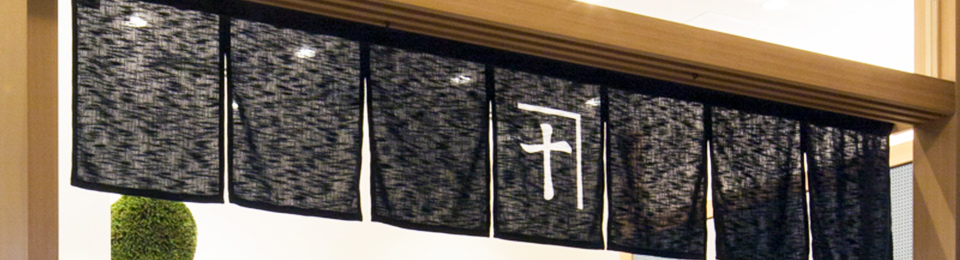
The trade mark of Toshimaya is “Kane-ju”, and you can find it in “Edo Meisho-zue”. It is made of two parts; the outside part showing the “kane-shaku” (metal L-square in Japanese) and the inside part showing the character of “ju” (ten in Japanese).
A “kane-shaku” is a carpenter’s tool, and represents “stability”, and also “kane” means “money” in Japanese, so the “kane-shaku” is thought to link with “prosperity”. Many old shops use this “kane-shaku” for their trade marks. The character of “ju” is a part of the name of “Juemon”.
It is thought that our trade mark was decided in the Edo era to honor the founder and to hope for stability and prosperity as well.